Best Instrument for a Child to Learn: A Parent’s Guide to Choosing the Right Music Lessons
Choosing the right instrument for your child can feel like a big decision. Piano, violin, guitar, voice, flute, and other instruments can all provide valuable musical experiences, but the best choice depends on your child’s age, interests, personality, learning style, and goals.
The good news is that there is no single “best” instrument for every child. The right instrument is the one that keeps your child interested, motivated, and excited to practise and learn.
If you are considering music lessons for kids in Coquitlam, understanding the strengths of different instruments can help you make a confident decision.
What Is the Best Instrument for a Child to Learn?
For many children, piano is an excellent starting point because it provides a clear visual layout of musical notes and helps students develop fundamental skills in rhythm, melody, harmony, and music reading.
However, piano is not the only good option. Violin, guitar, voice, flute, and other instruments can also be excellent choices depending on the child.
The most important question is not simply, “Which instrument is easiest?” Instead, ask: “Which instrument is my child most interested in?” A child’s enthusiasm can make a significant difference in their willingness to practise and continue with lessons.
Piano: A Strong Foundation for Young Musicians
Piano is one of the most popular choices for children beginning their musical education. Its layout makes it easier to introduce concepts such as pitch, rhythm, chords, scales, and music notation.
Piano lessons can also provide a strong foundation for students who may eventually want to study composition, music theory, or another instrument.
Piano may be a good choice if your child enjoys keyboards, likes structured activities, wants to learn melodies and songs, or wants to develop music reading skills.
Explore piano and other music lessons at Vancouver Conservatory of Music.
Violin: Great for Developing Listening and Technique
Violin is another excellent instrument for children, particularly those who enjoy classical music and want to develop strong listening and performance skills.
Unlike piano, the violin does not have keys that show exactly where each note should be played. Students therefore develop pitch awareness and physical technique through guided instruction and regular practice.
Learning violin can help children develop listening skills, coordination, concentration, musical expression, and performance confidence.
Guitar: A Popular Choice for Older Children and Teens
Guitar can be particularly appealing to children and teenagers who enjoy contemporary music, popular songs, rock, folk, or acoustic music. Learning guitar can introduce students to chords, rhythm, melodies, music notation, and accompaniment.
It can also be motivating for students who want to learn songs they already know and enjoy.
Guitar may be a good option if your child loves popular or contemporary music, enjoys rhythm-based activities, wants to accompany singing, or prefers a portable instrument.
Voice and Singing: An Instrument Every Child Already Has
Some children are naturally drawn to singing rather than playing an instrument. Voice lessons can help young singers develop breath control, pitch, musicality, diction, confidence, and performance skills.
For children who enjoy performing, musical theatre, or vocal music, singing lessons may be a natural fit. Voice training can also complement instrumental study.
What Age Should a Child Start Music Lessons?
There is no universal age at which every child should begin music lessons. Some children show an interest in music at a very young age, while others become more motivated as they get older.
Readiness can depend on the child’s ability to follow simple instructions, attention span, interest in music, willingness to practise, and physical readiness for the chosen instrument.
Vancouver Conservatory of Music offers programs for children, youth, and adults, with different learning formats and musical goals.
Should Parents Choose the Instrument or the Child?
Ideally, choosing an instrument should be a shared decision. Parents can introduce different possibilities, but the child’s interests should be part of the conversation.
What instrument sounds most interesting to you?
Is there a musician you admire?
What kind of music do you enjoy listening to?
Would you rather play melodies, chords, or sing?
Would you enjoy performing for others?
You can also let your child listen to different instruments or watch performances before making a decision. The goal is to create a positive connection between the child and their chosen instrument.
What If My Child Changes Their Mind?
This is completely normal. Children’s interests can change as they grow. A child who starts with piano may later become interested in guitar, singing, violin, composition, or another area of music.
The first instrument does not have to be a lifelong commitment. Early music education is about developing musical foundations, confidence, discipline, creativity, and an appreciation for learning.
How Often Should Children Practise?
Consistent practice is generally more useful than occasional long practice sessions. For beginners, parents can help establish a simple routine that fits naturally into the child’s schedule.
A successful practice routine should be consistent, age-appropriate, positive, focused on achievable goals, and supported by the instructor. Parents should avoid turning practice into a source of constant pressure.
Should You Choose Private or Group Music Lessons?
Both approaches can have advantages. Private lessons allow an instructor to focus closely on the individual student’s technique, progress, learning style, and musical goals. Group programs can provide opportunities for collaboration, social interaction, and ensemble experience.
The right option depends on the child’s personality, goals, experience level, and preferred learning environment.
Families considering music lessons in Coquitlam can explore Vanco’s range of programs and lesson formats.
What Should Parents Look for in a Music School?
Experienced instructors: Look for teachers who can work with your child’s age and experience level.
A structured learning approach: A clear progression can help students understand what they are learning and how they are improving.
Flexible lesson options: Families may benefit from different lesson lengths and learning formats.
Performance opportunities: Recitals, concerts, festivals, and other performance opportunities can help students develop confidence.
A supportive environment: Children are more likely to enjoy music when they feel encouraged and comfortable asking questions, making mistakes, and improving.
Vancouver Conservatory of Music offers structured music education for children, youth, and adults across multiple instruments and musical disciplines. The school also offers in-person, online, and hybrid learning formats, as well as preparation for RCM examinations, auditions, competitions, performances, and other musical goals.
Finding the Right Music Lessons for Your Child in Coquitlam
There is no single instrument that is perfect for every child. Piano can provide a strong musical foundation. Violin can develop listening, technique, and expressive skills. Guitar can appeal to students interested in contemporary music and rhythm. Singing can help children develop their voice and performance confidence.
The best choice is the one that matches your child’s interests, goals, personality, and readiness.
If you are looking for music lessons for kids in Coquitlam, Vancouver Conservatory of Music offers programs for children, teenagers, and adults.
Ready to Start?
Choosing an instrument is the beginning of a musical journey. With the right instructor, structured guidance, and a supportive learning environment, children can develop skills that extend far beyond music.
Contact Vancouver Conservatory of Music to discuss your child’s interests, goals, and the most suitable music program.
Frequently Asked Questions
What is the easiest instrument for a child to learn?
There is no single easiest instrument for every child. Piano is often considered a strong starting point because the layout makes musical notes and basic concepts relatively easy to visualize, but a child’s interest and motivation are equally important.
What is the best first instrument for a 5-year-old?
The best choice depends on the child’s development, interests, attention span, and readiness. Age-appropriate introductory music programs can help parents determine which type of learning is most suitable.
Is piano or violin better for a child?
Neither is universally better. Piano can provide a broad foundation in melody, harmony, rhythm, and music reading, while violin can develop listening, pitch awareness, technique, and expressive playing. The child’s interests should be considered when choosing between them.
Can children learn more than one instrument?
Yes. Some students eventually study multiple instruments. However, beginners may benefit from developing a strong foundation in one instrument before adding another.
Does Vancouver Conservatory of Music teach children?
Yes. Vancouver Conservatory of Music offers music programs for children, youth, and adults across multiple instruments and musical disciplines.
What music lessons are available at Vancouver Conservatory of Music?
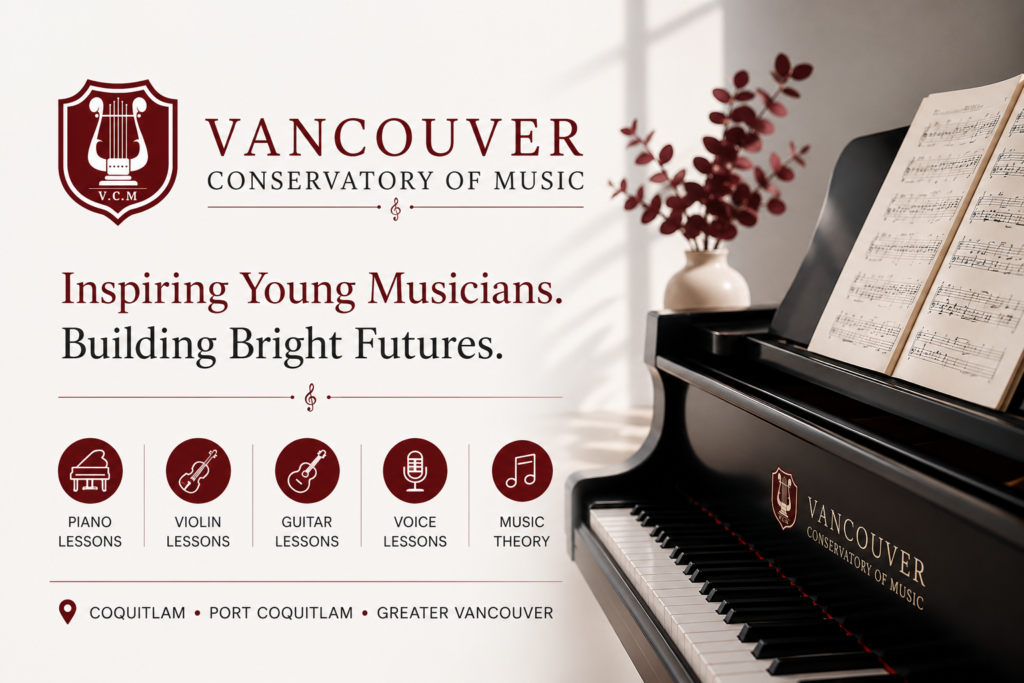
Programs include piano, violin, voice, guitar, cello, flute, music theory, composition, songwriting, and music technology, along with RCM preparation and other musical training options.